Saturday, June 25, 2022

Distant Dawns


Planet Parade, June 26, 2022; 4:45 a.m.

The night of June 25th, 2022, presented a rare opportunity for earthbound observers to view all the naked eye solar system planets at once. As a bonus, the crescent moon would be out close to the ecliptic making it a truly rare alignment. 

Up to three planets at a time are a relatively common sight I had recorded before but all five would be a personal first. In the run up to this day, the images poured in from various astro-photographers on social media. They looked beautiful, but also more similar than not. 

To change things up a bit, I planned to capture the event in two different ways. The first, would be a customary panoramic still as seen from the east facing window of my bedroom. The second would be a timelapse which would catch all the action.

Wednesday, June 22, 2022

Brighter Than a Billion Suns


Source: Sky and Telescope Credit: Purnendu Gupta

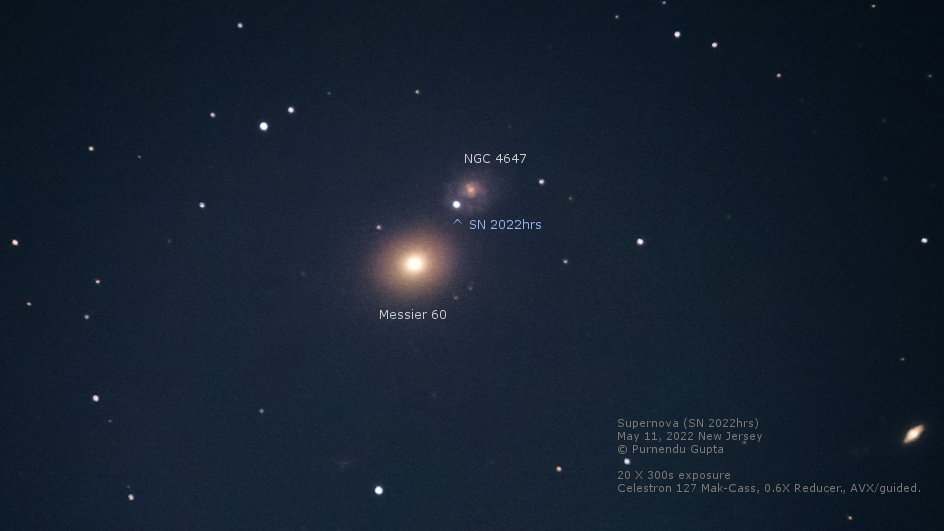
What kind of “explosion” lasts for months and outshines a billion suns? If you haven’t guessed it, it’s the average garden variety supernova. 

Above is my first supernova image captured from my backyard on the night of May 11-12, 2022. Known as SN2022hrs, it shows up here as a white dot between two galaxies - the elliptical Messier 60 and smaller spiral NGC4647. This light from sixty three million light years away, is also sixty three million years old. Breaking news from a time when dinosaurs had just vanished from the earth.

Sunday, May 1, 2022

Connecting the Dots


Four planets line up outside my bedroom window just before sunrise today (April 29).
The planets and the sun seem to lie on a single straight line. While it may seem like a lucky shot, this alignment is anything but momentary. 

Monday, March 7, 2022

A Dark Knight


Horsehead Nebula
Image Credit; Purnendu Gupta
Dense black clouds in the form of a horse’s bust, rise from the backdrop of a glowing red veil. Like a black knight in chess. The gash of red across, billowing black plumes with dabs of blue - paint a magnificent, almost ominous scene. Nature's watercolor of a knight about to make its move in a celestial game of chess in play.

The Horsehead nebula (Barnard 33) is a dark nebula in Orion. Among the night sky wonders I have seen - this is perhaps the object which most closely resembles its common name. But its nature was unknown till a hundred years after it’s discovery.

Friday, January 21, 2022

Leo's Trio - Through A Cosmic Rabbit Hole

The Leo Triplet

The Leo Triplet - or Leo’s Trio as I like to call them. Three galaxies near the tail of Leo the lion, 35 million light years away. Ancient photons that started out when yet another mass extinction was unfolding on the earth 35 million years ago - and the Antarctic ice sheet was only beginning to take shape. They finally arrived yesterday, fresh as daisies. Relativistically for photons, time stands still. 

This is my first deep-sky image of 2022, and also possibly among the farthest objects I have ever imaged. I like to pretend this is a (very) poor man’s version of the iconic “Hubble ultra deep field” photo taken by the Hubble space telescope.

Monday, October 11, 2021

Jewels on the Ecliptic


On an early October evening I stepped out of my door to be pleasantly surprised by this string of pearls in the sky. 

It was approaching nautical twilight. The brightest stars were becoming slowly visible and the last traces of sunset glow had faded. Jupiter, Saturn and Venus formed a vaulted arc across the sky and over our rooftops marking the plane of the ecliptic. The yellow dot on the left was unmistakably Jupiter, lofted high in the sky. It’s light a beacon frozen in time. Calm, unchanging, out of reach as if on purpose. Saturn was a few degrees to the west, and a billion miles away. Fainter, yet distinct. In the west, Venus, easily mistaken for an airplane light, shone through a wisp of cloud, racing for the distant rooftops. In the center of the view, a three quarters moon hung close to the southern horizon - near Sagittarius. The teapot’s spout tipped towards the core of the Milky Way hidden behind the suburban light dome. In a few days the galactic core would dip below the horizon to hibernate in its winter lair.

The sky was less than perfect - a hint of haze, a thin veil of cloud obscuring the moon and Venus. And yet this moment, this arrangement seemed special. A congregation of visitors that showed up at my front door - unannounced - spanning the entire field of view as if to not leave the viewing to chance.  

I grabbed my camera - plopped an ultra wide lens on it,  set it on a tripod and clicked away.

The above is a single shot processed separately for the sky and earth - in an effort to mimic what the scene looked like to the naked eye.


Sunday, June 27, 2021

Sunspots and Star Stuff: The Story of Payne


Sunspots, 12 of them to be precise, appear clustered in two active regions (AR2835 and 2836) in this image captured on a Sunday afternoon from my backyard (June 27, 2021). The larger spots show clear definition of umbra and penumbra after image processing. The capture process started with a video clip shot with an SLR attached to a scope, which is then used as a source of numerous stills which are "stacked" by software to produce a single sharp image - an approach I have described on prior posts. 

The "little" spots on the face of the sun are not so little in some ways. The larger ones in the active region AR2835 here, are actually larger in size than the earth.

Thursday, April 1, 2021

A Pre-Miocene Mirage


The graceful Whirlpool galaxy (Messier 51) in a gravitational embrace with its companion. 

At the center of what is known as a grand design galaxy, space swirls around and disappears into a black hole. Just like water swirling down a bathtub or kitchen sink drain. What we see as the spiral arms are the trail of stars and dust as they follow the swirling curves in spacetime.

Wednesday, March 24, 2021

An Ancient Owl (that isn't there)


The Owl Nebula a planetary (starburst) nebula about 2000 light years away in Ursa Major, shot from my backyard on March 24, 2021. At a magnitude of 9.9 it is a very faint target for my street-light bathed backyard, but a 5 inch scope at 90 second exposures begins to pull in the details of the owl-eyes. The two circular dark spots in a green orb give it an owl-eye like appearance. The central star approaching a white dwarf stage in it’s lifecycle. But of course, despite the tempting likeness, there’s no owl there. In fact its not green either. More on that later.

Tuesday, February 2, 2021

Copernicus and Co.

Craters at lunar terminator © 2020 Purnendu Gupta

The moon's craters, seen in the lunar twilight zone. At the lunar terminator,  fading sunlight meets near perfect darkness of an airless lunar night disturbed only by the faint glow of earthshine. The grazing rays cast long shadows into the crater pits as the edge of light creeps up the shallow slopes to the rims on the far side. 

On the 3rd of December 2020, this was among the first results from my attempt at high magnification video based lunar imaging.