![]() |
| Animation of Jupiter's three nearest moons over 2.5 hours; Credit: Purnendu Gupta; Sep 26, 2022 |
Exploring picture postcards from lost times.
"The real voyage of discovery consists not in seeking new landscapes, but in having new eyes." - Marcel Proust
Monday, September 26, 2022
The Planets That Were Not
Saturday, August 13, 2022
To Catch A Falling Star: On A Perseid Trail
A glimpse of the Perseid meteor shower caught on camera on the Aug 12-13 night from my backyard. In this composite frame, four streaks can be seen (5 if you have a keen eye) through severe sodium vapor light pollution from the ground and the glow of a full moon behind camera.
Sunday, July 10, 2022
Colors of Starlight
| Albireo. Source: Sky and Telescope Credit; Purnendu Gupta |
Albireo in the constellation Cygnus is an optical binary star system, best known for its contrasting colors. To the naked eye, it appears as a single star near the beak of Cygnus, the swan, as it flies with its wings spread and neck along the center line of the Milky Way on summer nights. But in almost any small telescope it splits into a striking blue-gold pair. One of the two points of light, yellow-gold Albireo A , is itself a suspected four star system. The primary is a red giant about 60 times larger than the sun. The other, Albireo B, is a blue-white main sequence star
The first image is through a telescope shot on July 12, from my backyard. The second below, showing Albireo in Cygnus and a single meteor in Lyra, was shot with a wide lens in April, 2020
Saturday, June 25, 2022
Distant Dawns
![]() |
| Planet Parade, June 26, 2022; 4:45 a.m. |
The night of June 25th, 2022, presented a rare opportunity for earthbound observers to view all the naked eye solar system planets at once. As a bonus, the crescent moon would be out close to the ecliptic making it a truly rare alignment.
Wednesday, June 22, 2022
Brighter Than a Billion Suns
![]() |
| Source: Sky and Telescope Credit: Purnendu Gupta |
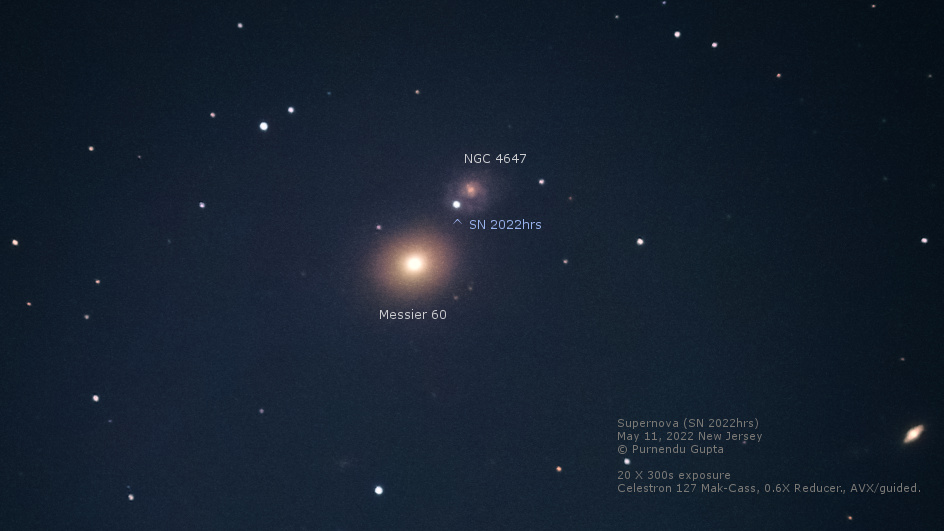
What kind of “explosion” lasts for months and outshines a billion suns? If you haven’t guessed it, it’s the average garden variety supernova.
Above is my first supernova image captured from my backyard on the night of May 11-12, 2022. Known as SN2022hrs, it shows up here as a white dot between two galaxies - the elliptical Messier 60 and smaller spiral NGC4647. This light from sixty three million light years away, is also sixty three million years old. Breaking news from a time when dinosaurs had just vanished from the earth.
Sunday, May 1, 2022
Connecting the Dots
Monday, March 7, 2022
A Dark Knight
| Horsehead Nebula Image Credit; Purnendu Gupta |
The Horsehead nebula (Barnard 33) is a dark nebula in Orion. Among the night sky wonders I have seen - this is perhaps the object which most closely resembles its common name. But its nature was unknown till a hundred years after it’s discovery.
Friday, January 21, 2022
Leo's Trio - Through A Cosmic Rabbit Hole
| The Leo Triplet |
The Leo Triplet - or Leo’s Trio as I like to call them. Three galaxies near the tail of Leo the lion, 35 million light years away. Ancient photons that started out when yet another mass extinction was unfolding on the earth 35 million years ago - and the Antarctic ice sheet was only beginning to take shape. They finally arrived yesterday, fresh as daisies. Relativistically for photons, time stands still.
This is my first deep-sky image of 2022, and also possibly among the farthest objects I have ever imaged. I like to pretend this is a (very) poor man’s version of the iconic “Hubble ultra deep field” photo taken by the Hubble space telescope.
Monday, October 11, 2021
Jewels on the Ecliptic
On an early October evening I stepped out of my door to be pleasantly surprised by this string of pearls in the sky.
It was approaching nautical twilight. The brightest stars were becoming slowly visible and the last traces of sunset glow had faded. Jupiter, Saturn and Venus formed a vaulted arc across the sky and over our rooftops marking the plane of the ecliptic. The yellow dot on the left was unmistakably Jupiter, lofted high in the sky. It’s light a beacon frozen in time. Calm, unchanging, out of reach as if on purpose. Saturn was a few degrees to the west, and a billion miles away. Fainter, yet distinct. In the west, Venus, easily mistaken for an airplane light, shone through a wisp of cloud, racing for the distant rooftops. In the center of the view, a three quarters moon hung close to the southern horizon - near Sagittarius. The teapot’s spout tipped towards the core of the Milky Way hidden behind the suburban light dome. In a few days the galactic core would dip below the horizon to hibernate in its winter lair.
The sky was less than perfect - a hint of haze, a thin veil of cloud obscuring the moon and Venus. And yet this moment, this arrangement seemed special. A congregation of visitors that showed up at my front door - unannounced - spanning the entire field of view as if to not leave the viewing to chance.
I grabbed my camera - plopped an ultra wide lens on it, set it on a tripod and clicked away.
The above is a single shot processed separately for the sky and earth - in an effort to mimic what the scene looked like to the naked eye.
Sunday, June 27, 2021
Sunspots and Star Stuff: The Story of Payne